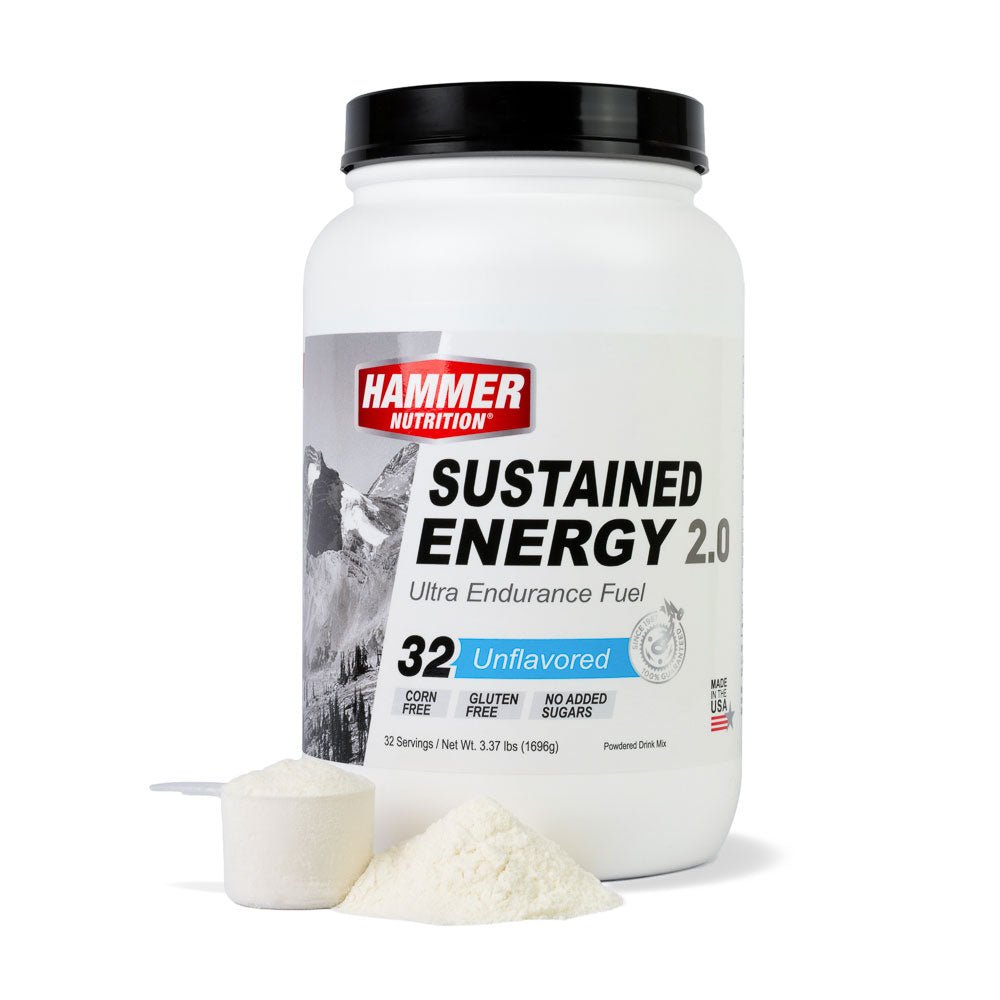
Why is the maltodextrin in Sustained Energy made from tapioca?
Our carbohydrate-containing Hammer fuels used to contain corn-derived maltodextrin (a complex carbohydrate), which was actually a very good maltodextrin. However, maltodextrin made from tapioca (cassava root) offers several advantages, which is why we made the switch:
- Tapioca requires far less processing than corn.
- Tapioca is not a GMO crop to begin with. The corn maltodextrin we used before also tested GMO-free, but with tapioca the question doesn't even arise.
- Tapioca maltodextrin naturally contains less sodium and more potassium.
- Its pH is more alkaline than that of corn-derived maltodextrin, which is an advantage during exercise, since your body produces a lot of acid when working hard.
- It has a lower dextrose equivalent (DE), meaning it contains fewer short-chain sugars (mono- and disaccharides) and a much higher proportion of complex carbohydrates (polysaccharides) – this provides steadier, longer-lasting energy.
- Its glycaemic index is the same as that of other maltodextrins, so it provides the same fast-acting energy.
Read more: Six Reasons Why Tapioca is TOPS!
Sustained Energy or Perpetuem – which one should I use?
Hammer offers two long-distance powdered fuels: Sustained Energy and Perpetuem. You can use either one as your primary or sole fuel source for efforts longer than 2 hours. Which one you choose (or whether you use both) is largely a matter of personal preference, but a few differences may help:
- Energy: a 2-scoop serving of Perpetuem provides 180 kcal, a serving of Sustained Energy 200 kcal.
- Composition: Sustained Energy contains complex carbohydrates and soy protein in a ratio of about 7:1, with no fat. Perpetuem has a carbohydrate-to-protein ratio of about 8:1 and also contains 2 g of fat per serving (soy lecithin). In our experience, the fat also acts as a natural preservative, may help you make use of your fat stores, and slightly slows digestion, which reduces hunger.
- Sodium phosphate: found only in Perpetuem; as an acid buffer, it helps neutralise the acids produced during exercise. Both products contain L-carnosine.
- Flavour: Sustained Energy is unflavoured, while Perpetuem comes in 4 flavours (Caffe Latte, Chocolate, Orange, Strawberry; Caffe Latte contains 30 mg of caffeine per serving).
Experience shows: at higher intensities (about 70–85% of your maximum heart rate), Sustained Energy may be ideal, while Perpetuem suits longer efforts in the aerobic zone (below about 70% of your maximum heart rate). Very lean athletes often do better with Sustained Energy, while those with a higher body fat percentage tend to prefer Perpetuem.
Bottom line: try both in long workouts under different conditions – that's how you'll find out which one works best for you. You can also combine them.
How should I prepare Sustained Energy for a race in hot weather?
- Mildly warm weather: prepare your multi-hour bottles the night before and freeze them. In a long-distance triathlon, both can go on the bike (or one at an aid station); in an ultra run, carry one and leave the other in a small cooler bag at an aid station.
- Hot weather: simply freeze the first bottle. Before freezing the second one, wrap a wet towel or cloth around it and secure it with a rubber band – the frozen cloth adds extra insulation. Put this bottle at a later aid station or in your “special needs” bag.
- Very hot weather: carry the first, frozen bottle with you. The second contains only the powder: at the aid station, add cold water and mix. The short stop is worth it, because you'll have a fresh, cold drink for the hours ahead.
Can I mix it in advance and keep it in the fridge?
Yes. For best results, use a pre-mixed bottle kept in the fridge within 48 hours. You can also freeze it – there's no time limit on a frozen mix.
Small crystals may sometimes form around the top of the bottle. These are caused by L-carnitine, which binds water strongly. The crystallisation is harmless and the product is still fine to consume – at most, the effectiveness of the L-carnitine may be slightly reduced.
How soon do I need to drink the mixed drink?
In moderate temperatures, a mixed bottle of Sustained Energy or Perpetuem keeps for about 5 hours, possibly a little longer. In warm weather this time is shorter – in extreme heat it may be as little as 2 hours. If you freeze the mixed bottle the night before, it stays cold longer and keeps longer.
How much is one scoop of Sustained Energy if I don't have the scoop to hand?
1 level scoop of Sustained Energy (50 cm³) = 3 tablespoons + 1 teaspoon. One serving is 2 scoops (53 g, about 200 kcal).
Why did the serving size change?
The original “mega” serving of about 320 kcal was too large and encouraged many athletes to overconsume calories – the exact opposite of what we stand for: less is often more. Almost all of the earlier complaints came from people taking in too many calories per hour. About 180–200 kcal per hour is close to what works for most athletes; some need less, others a little more. Start with one serving per hour and adjust up or down from there.
If you prefer the old serving size: one scoop provides about 100 kcal, so 3 scoops are almost the same as the old serving.
Why doesn't it contain electrolytes?
On purpose: this way you can dose energy and electrolytes independently of each other, tailored to your own needs, the weather and how much you sweat. With a single-hour bottle, supplemental electrolytes are enough, but with a multi-hour bottle or a paste you need to get both fluids and electrolytes from a separate source – for example plain water and Endurolytes or Endurolytes Extreme.
Can I use Recoverite during a long workout or race?
We don't recommend it, for two reasons:
1) Recoverite's 3:1 carbohydrate-to-protein ratio isn't harmful, but it isn't ideal during exercise. While you're exercising, only a small part (about 8–12%) of your body's energy needs should come from protein, so a ratio of around 7:1 or 8:1 is ideal. That's exactly what Sustained Energy and Perpetuem are made for.
2) The main reason is the added L-glutamine. Glutamine is a very beneficial amino acid, but when it is first metabolised it produces some ammonia. After exercise this isn't a problem, but during exercise your body is already producing ammonia, which is one of the main causes of fatigue, and you don't want to add to it. After about 3 hours, glutamine actually helps neutralise ammonia, but during exercise you don't have that much time.
For best results, use Sustained Energy or Perpetuem during exercise and save Recoverite for afterwards.
Why does Hammer use maltodextrin instead of sugar?
Here are the benefits of maltodextrin, along with information about its effect on insulin during and after exercise.
The benefits of maltodextrin
- You can digest more calories from maltodextrin than from short-chain, so-called simple sugars (glucose, sucrose, fructose). As one nutritional scientist puts it, maltodextrin lets you take in more energy in less volume. Simple sugars can only be digested efficiently in weak, low-calorie solutions, so you can't get enough energy from them. But if you make a “double-strength” mix, the overly concentrated sugar solution sits in your stomach for a long time and can cause serious stomach distress. You won't have that issue with maltodextrin.
- Maltodextrin provides fast-acting energy because it's a high-glycaemic carbohydrate – its glycaemic index is the same as glucose. At the same time, because it is made up of many weakly bonded sugar units, it provides more consistent, longer-lasting energy than glucose or other simple sugars, without the sudden “peak and crash” typical of simple sugars.
Because of the high glycaemic index, many people ask about insulin. Maltodextrin does raise blood sugar quickly and triggers an insulin response. Immediately before and during exercise, however, this is not an issue. As Dr. Bill Misner explains, during exercise the hormones of the sympathetic nervous system inhibit insulin release, and exercise itself increases the muscles' uptake of the glucose you take in. So insulin is not a significant factor during exercise.
After exercise, when your body needs to restock its energy stores, a high glycaemic index is also an advantage. That's exactly the purpose of Recoverite and Vegan Recoverite.
These are the three times – immediately before exercise, during exercise and shortly afterwards – when it makes sense to consume a high-glycaemic carbohydrate such as maltodextrin.
How can I avoid clumping when mixing?
First fill your bottle about a third of the way with water, and only then add the powder – if you pour water onto the dry powder, it clumps easily. Close it and shake well. Then add a little more water, shake again, and repeat until the bottle is full. This is especially important for more concentrated bottles mixed to last several hours.
Vegan? Gluten-free?
Yes: Sustained Energy 2.0 is vegan, gluten-free and kosher. It contains soy and is made in a facility that also processes milk, eggs and wheat.